
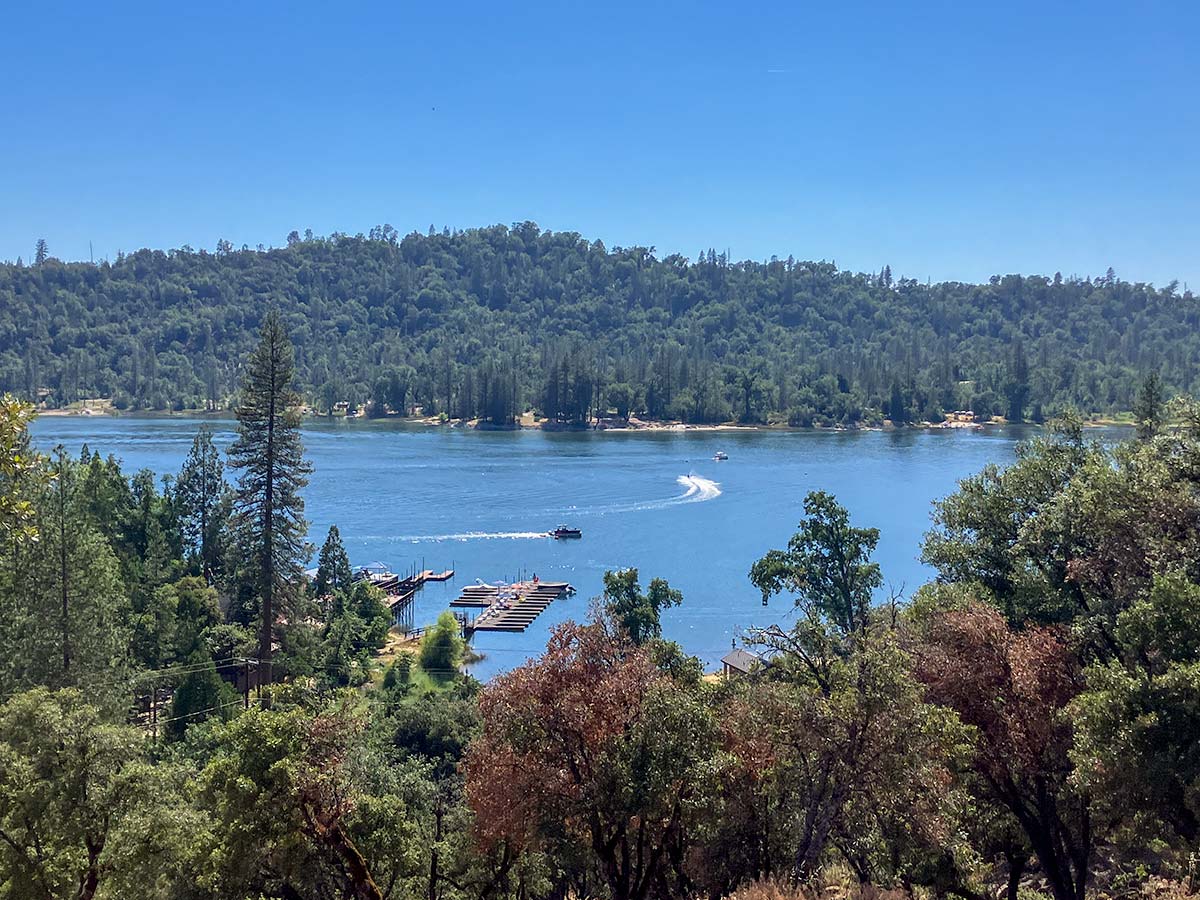
A Brief History of Bass Lake California
Like many lakes in California, Bass Lake was born from an ancient meadow. Before the dam at the south end of today’s lake was constructed, the entire basin was known as Crane Valley. It was ringed by pine forest, drained by Willow Creek, grazed by cattle and logged for timber. The lake we all know today, with its marinas and Fourth of July fireworks and lakefront resorts, is a byproduct of hydroelectric engineering that started way back in 1895.
This is the story of how that happened: who built the dam, who opened the first resorts and who came to stay, how a cluster of PG&E cabin leases turned into a real town, and what goes on at Bass Lake now that the meadow has been underwater for more than a century.
We’ve always found that knowing a bit about the past makes it easier to appreciate the present. And it’s a good story too!

Before the Water: Crane Valley
The Chukchansi people lived in Crane Valley for centuries before the Mono people arrived roughly two hundred years ago and squeezed in alongside. In January 1851, a detachment of the Mariposa Battalion passed through shortly after discovering Yosemite Valley to the north. They spotted great blue herons wading in the wetlands and mistook them for sandhill cranes, so they named the meadow Crane Valley. The name held for the next sixty years and shows up on maps and land deeds long before the first drop of water was sequestered in Bass Lake.
The first sawmill in Crane Valley went up in 1854 at the base of Willow Creek falls. It was the first lumber mill in what’s now Madera County, and it set the tone for the area as a working forest, not a resort destination, for the next seventy years.
Building Crane Valley Dam
San Joaquin Electric Company got the ball rolling in 1895, looking for a way to turn Willow Creek into power for the lower elevation farms and towns in Madera County. Their first attempt, a simple earthen dam, went in by 1901, with mules dragging equipment up the grade and hauling cleared timber back down.
A corporate merger folded that company into San Joaquin Light and Power in 1902 and the dam kept growing under new ownership. It got bigger in 1905, and was then rebuilt with concrete in 1910 to today’s full 145-foot height. PG&E acquired the entire project decades later and now owns and operates the dam as part of the Crane Valley Hydroelectric Project. The most recent major work happened between 2009 and 2012, when PG&E poured $63 million into an earthquake retrofit, packing in enough rock to raise the dam’s crest another eight feet. No wonder our electric rates keep going up! That’s some expensive rock.
The name “Crane Valley Reservoir” stuck around on maps for years after the dam went in, right up until a logging operation upstream fouled the water badly enough to wipe out the fish. Restoration requirements forced the company to restock the lake and, guess what, they chose bass…and Bass Lake was born-anew.
The Sugar Pine Lumber Company Years
Logging activity accelerated after that first 1854 sawmill, reaching its peak in the 1920s. The town of Wishon, on the lake’s western shore, became headquarters for the Sugar Pine Lumber Company, which turned out to be the last major logging operation established in the southern Sierra Nevada. The company ran a twelve-mile rail line from Bass Lake to its main logging site at Central Camp, with grades up to 4.5 percent, steep enough to challenge any locomotive of the era. The railroad never turned much of a profit, and in its last two years it ran briefly as a tourist line out of Pinedale before shutting down for good in 1931.
By the way, this is the same Madera Sugar Pine Lumber Company whose old flume route eventually became the Lewis Creek Trail. Corlieu Falls and Red Rock Falls sit along that same 1920s logging corridor. It’s hard to imagine how they moved the logs through those steep canyon drops.
The Pines Resort Sets the Stage
Tourism to the area that would become Bass Lake actually got started during the logging boom. Two former vaudeville performers, William Day and William Haskell, opened The Pines Resort in 1901, the same year work started on the original earthen dam. They set up a small sawmill at Willow Creek, put up a handful of cabins, and started welcoming guests who showed up by horse and buggy, making theirs the first real resort in Crane Valley.
By the 1920s, the marketing pitch started to get a bit sharper. One period ad billed the resort as, “the coolest place in California,” aimed squarely at Fresno families trying to escape the summer heat. Another target audience was the growing stream of motorists working their way up Highway 41 toward Yosemite. Most of them wanted a comfortable landing spot to break up the drive. And The Pines offered something many rural accommodations of the period did not: a private bathroom attached to every cabin. Imagine the luxury!
Things shifted a bit by the mid-1930s as Bass Lake developed into something of a destination of its own. The Pines Resort’s dining room became known for its white tablecloths, a formal dress code and set mealtimes announced by a bell. Guests were expected to dress for dinner. The resort ran its own small post office and a single manually operated telephone line. For a time, rustic cabins gave way to an upscale mountain retreat, closer in spirit to a Yosemite grand hotel. It was all a far cry from the casual, shorts-and-flip-flops town that Bass Lake is today.
🌲 Host Insider Tip
The same Sugar Pine Lumber Company that ran the rail line out of Wishon also built the community of Sugar Pine, where we now host guests at Boom Chalet. Sugar Pine originated as a logging camp in the 1920s, nine miles from Yosemite’s South Entrance and a short drive from Bass Lake itself. A lot of these small Sierra mountain towns around here trace their origins back to a handful of rugged and scrappy logging ventures.
From Leased Cabins to a Real Town
While the resort business was perhaps the most obvious change happening around Bass Lake, an actual town also started to emerge. Private cabins first went up on the lake’s north shore in the 1930s. PG&E owned the land as part of its hydroelectric holdings and homeowners built under sub-lease agreements with the utility. That cluster became known as the Pines Tract, and it remained a leasehold arrangement for six decades. That changed in 1992, when PG&E transferred roughly 125 of those acres to a newly organized Bass Lake Homeowners Association, which finally gave Pines Tract residents title to the actual ground under their cabins.
Bass Lake filled in around those cabins through the middle of the century. Wishon got its own small airstrip in June 1937, an unpaved one-way runway the Forest Service built mainly for its own use, though private pilots landed there too. The approach ran directly over open water. The FAA declined to certify it for continued use once it reviewed the strip in the 1960s, and it sat idle before finally closing in the 1980s. Housing was eventually built over the old runway footprint.
Bass Lake Elementary opened on the north shore in 1947 and never enrolled more than about a hundred students in any given year. It closed in 2010 when enrollment fell all the way down to 44.
Notably, Buddy Freeman built a lodge on the north shore in 1941, with a bar, a restaurant, and a handful of rental cabins. Maurice and Marie Ducey of Fresno bought it in 1950 and renamed it Ducey’s Bass Lake Lodge, adding a general store and a campground over the following decade.
A fire destroyed The Pines Resort in December 1962. Construction on a new 16,000-square-foot building started the following January and reopened later that same year, built with cedar and pine finishes, peeled-pine posts, stone masonry, and a full-length covered porch. By 1967, the resort had grown into an entire commercial district known as Pines Village, encompassing a market, coffee shop, bar, laundromat, bakery, gift shop, movie theater (the Ponderosa), realty office, and an official US Post Office.
Ducey’s joined The Pines Resort in 1975, when Robert Stern and Rudy Schulte bought and expanded it into a single, full-service, year-round operation. By then, Bass Lake had long since proven it could draw a crowd. A 1955 Madera Tribune headline put annual visitation above the half-million mark, which was quite respectable for a lake that didn’t exist before 1901. And while we’re on the topic of Ducey’s, it’s worth noting that it achieved minor cult status in 1987 with a starring role as the setting for John Candy’s “Old-96er” scene in The Great Outdoors.
Unfortunately, encore performances of Candy’s legendary steak takedown are not on the menu these days.
The Hell’s Angels Years
Starting in 1963, Bass Lake picked up another odd claim to fame. The Hells Angels Motorcycle Club began holding annual gatherings here, usually timed to Memorial Day or the Fourth of July, and riders came in from across California. The biggest of these runs, in July 1965, drew national press coverage from Newsweek and Life Magazine, along with a full chapter in Hunter S. Thompson’s book Hell’s Angels after Thompson attended in person.
Worried about trouble, Madera County was prepared with a court injunction and roadblocks staged around the lake. In the end, the run produced little beyond a few public intoxication arrests. Thompson’s own account credited the deft touch of the area’s bars and shopkeepers for keeping things under control. They mostly kept serving instead of turning people out, which mostly kept everyone happy and off the street. The runs continued through the 1970s and then mostly faded out by the 1980s.
Public Land & West Shore Beaches
After the bikers stopped coming, Bass Lake settled into a quieter more leisurely routine. Most of the land around Bass Lake, aside from the private Pines Tract, is part of the Sierra National Forest and is managed as the Bass Lake Recreation Area. Rocky Point and The Falls are both U.S. Forest Service day-use picnic sites, part of roughly ten such spots scattered around the lake, and each charges a modest day-use fee for parking.
Camping is offered at five developed campgrounds, including Forks Campground (31 sites, open Memorial Day through Labor Day), Lupine and Cedar Bluff (113 sites combined, open year-round), Spring Cove (63 sites, open April through Labor Day), Wishon Point (47 sites, open Memorial Day through Labor Day), and Recreation Point, a tent-only group site.
Historic Resorts Still Open Today
Four historic businesses continue to operate in Bass Lake, in some cases run by the same families who founded them:
Bass Lake in 2026
The 2020 Census counted 575 year-round residents at Bass Lake, with nearly half the population 65 or older. Only about one in ten residents is under 18. Of the 868 housing units in the census area, two-thirds sit vacant most of the year, which tells you a lot about how this quintessential California lake town works. It’s mostly a summer vacation-home community with a small and aging year-round population that holds down the fort the rest of the year.
These days, the visitor mix has broadened well beyond the Fresno day-trippers who flocked to the lake in the 1950s. Boating is still the single most popular activity on the water, alongside water skiing, wakeboarding, kayaking, jet skiing, and comfortable swimming in the shallow coves. Anglers rate it as one of the better fishing lakes in the Sierra Nevada, stocked with kokanee salmon, trout, and catfish. Short-term rental listings have grown fast in recent years too, with several hundred active Airbnb and Vrbo properties now operating around the lake. They are heavily booked in summer and mostly quiet the rest of the year.
Bass Lake has been many things to many people over the years. A meadow. A construction site. A vaudeville actor’s mountain retreat. A formal dining spot with a strict dress code. A Hells Angels rally point. A National Forest recreation area. A favorite fishing spot. What hasn’t changed much is its basic IRL appeal. It’s a warm-water lake set amidst a pine forest. It’s close enough to Yosemite to be a convenient waypoint and far enough from the park to feel like its own place.
If you want dive deeper into this special corner of the Sierra, our Yosemite Guide hub covers many aspects of Bass Lake, Oakhurst, Yosemite’s South Entrance, and the areas best trails and activities.
Ready for your Yosemite adventure?
Reserve Your Stay at Boom Chalet
Book direct to save ~10% vs. Airbnb and VRBO, lock in zero platform fees, and get personalized local host support.


